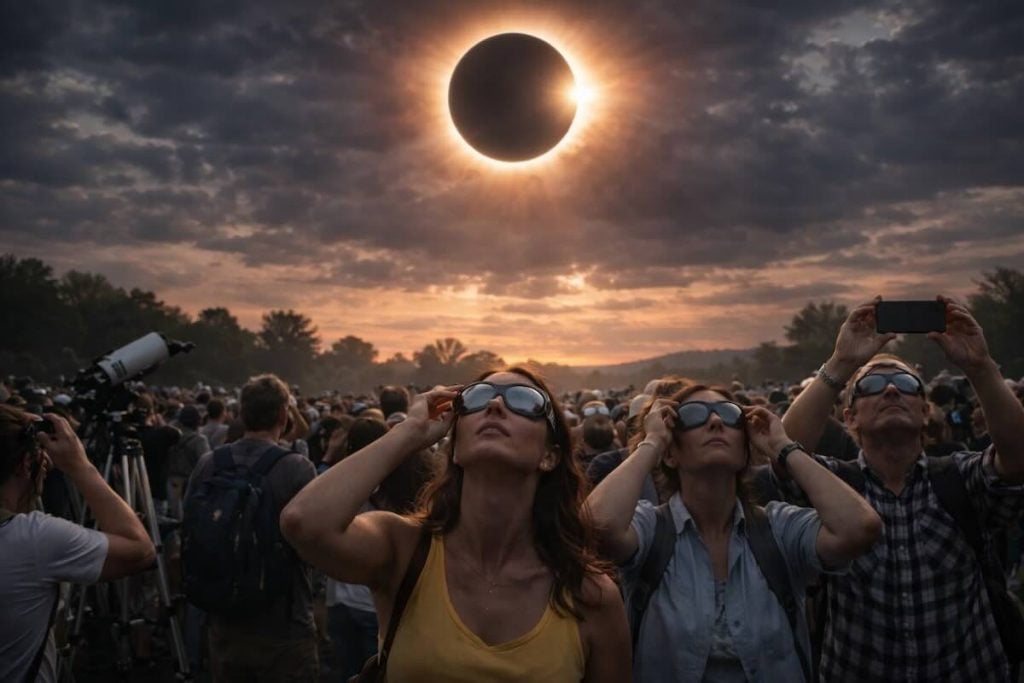
At first, no one on the pier believed the sky meant business. The sun was bright, children were busy with melting ice cream, and a vendor selling sunglasses joked that the darkness would ruin his sales for a few minutes. Then the light began to shift. It was subtle at first, like a dimmer slowly turning down. Shadows stretched into sharp, unfamiliar shapes. The air felt different. Birds stopped singing without warning, and conversations faded into a shared silence.
When the last thin edge of sunlight disappeared, a wave of sound rose from the crowd, part excitement and part fear. In the middle of the afternoon, it felt like midnight. Those few minutes seemed to expand, bending everyone’s sense of time and reality.
That surreal moment is exactly what millions of people will experience during the longest total solar eclipse of the century.
The Rare Day the Sun Will Disappear for Six Minutes
A total solar eclipse is always impressive, but this one will be unlike most people have ever seen. Instead of a brief blackout that comes and goes in a flash, the Moon’s shadow will cover the sun for nearly six full minutes in certain parts of the world. That is long enough for daylight to collapse into darkness and for the human brain to struggle to understand what is happening.
Astronomers explain that this rare duration is the result of a perfect alignment. The Moon will appear slightly larger in the sky, the Earth will be at the right distance, and the path of totality will be positioned in a way that allows the shadow to linger. These precise conditions do not happen often. When they do, they create an event that becomes part of history.
In the areas where totality is visible, streetlights may switch on automatically. Temperatures can drop within minutes. Animals often react as if night has arrived too early. Drivers slow down without knowing why. The world briefly steps out of its normal rhythm.
Why Six Minutes Feels So Much Longer
On paper, six minutes does not sound like much. In everyday life it passes quickly between two notifications or during a short break. Under a darkened midday sky, those same six minutes feel completely different.
During previous long eclipses, some people reported feeling dizzy as the light changed, as if the ground itself had shifted. Others described a silence that felt almost physical, a shared pause that moved through entire towns at once.
This happens because the human brain is not used to sudden, dramatic changes in natural light during the day. We are deeply connected to the sun’s cycle. When it disappears in the middle of the afternoon, even for a short time, it creates a powerful emotional response.
Where and How to Watch the Eclipse
You do not need expensive equipment or a complicated plan to experience this moment. The most important step is simply to make time for it. Many people miss astronomical events because they are stuck in meetings or distracted by daily routines.
If you live near the path of totality, choose your viewing spot early. An open area with a clear view of the sky is ideal. Bring certified eclipse glasses to protect your eyes during the partial phases, a chair for comfort, water, and a light jacket because the temperature may drop.
The partial eclipse will build slowly, sometimes for more than an hour, with the Moon gradually covering the sun. Then totality will arrive, and those long minutes will feel like seconds in your memory. Planning ahead helps you stay present instead of scrambling at the last moment.
Why You Should Not Watch It Through Your Phone
The instinct to record everything is strong, but a total solar eclipse is one of the few experiences that is far more powerful when seen directly. A photo or video cannot capture the sudden darkness, the cool air, the reactions of the people around you, or the strange glow on the horizon.
Taking one or two quick pictures is enough. After that, putting the phone away allows you to fully feel the moment. This is the kind of event that stays in memory not because of the images you saved, but because of how it made you feel.
A Shared Pause in a World That Never Stops
In a time filled with constant notifications and endless scrolling, the idea of an entire region stopping at once is almost unthinkable. Yet that is exactly what a total solar eclipse does. People step outside, look up, and share the same silent reaction.
Some will see it as a scientific phenomenon. Others will experience it as something deeply emotional or even spiritual. Many will simply enjoy the rare chance to stand still with strangers and feel connected to something larger than everyday life.
Children will ask questions that adults cannot easily answer. Some people will laugh out of pure amazement. Others may feel unexpectedly moved to tears. Years later, the most common question will not be about the science. It will be, “Where were you when the day turned into night?”
How Nature Reminds Us to Feel Small
Moments like this break the illusion that everything is under our control. The normal rules of the day vanish. The light changes. The temperature drops. The sky reveals how thin the line is between what we consider ordinary and something extraordinary.
For a few minutes, emails, deadlines, and headlines lose their importance. The universe performs a precise and silent alignment that has been happening for billions of years, long before humans gave it a name.
After the Light Returns
When the sun slowly reappears, the world will come back to life. Traffic will move again. Phones will start buzzing. Conversations will resume as if nothing had happened.
But something will have changed for those who witnessed it. The memory of standing under a darkened sky in the middle of the day will remain. It becomes a shared reference point, a story told for years, a reminder that not everything important happens on a screen.
The Best Way to Prepare for This Once-in-a-Lifetime Event
The most valuable preparation is not technical. It is emotional. Give yourself permission to stop, to look up, and to feel amazed.
This eclipse is not just an astronomical event. It is a rare opportunity to experience time differently, to share a moment of wonder with thousands of people at once, and to remember how powerful the natural world can be.
For six extraordinary minutes, noon will become night. And then, quietly and without asking anything in return, the day will begin again.